Quantum Information, Game Theory, and the Future of Rationality
Black Holes Have Bad Memories
I reframe the black hole horizon as a system with imperfect recall, in which local observers lose access to the history. This perspective suggests that quantum discord—a non-monogamous correlation that survives the horizon’s memory loss—may replace entanglement as the key mechanism. By shifting the focus to accessible memory, this approach offers a path to dissolving the firewall paradox while preserving both smoothness and unitarity.
Faisal Shah Khan, PhD
1/12/20264 min read
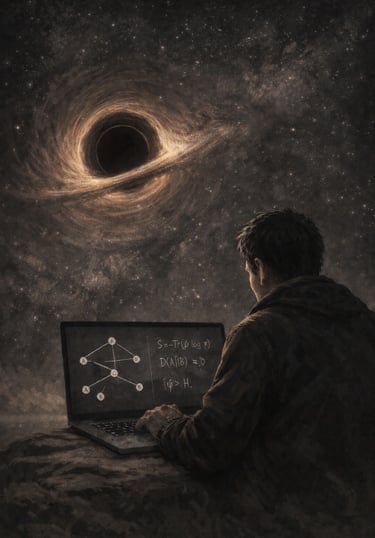
Modern physics has taught us to take paradoxes seriously. Again and again, apparent contradictions—between thermodynamics and mechanics, between locality and causality, between gravity and quantum theory—have turned out to be signposts rather than dead ends. The Black Hole Information Paradox is one of the sharpest of these signposts. For nearly half a century, it has forced us to confront an uncomfortable tension between quantum mechanics and general relativity, culminating more recently in the firewall paradox. Despite intense effort, there is still no consensus on what the horizon of a black hole really knows, remembers, or forgets. In what follows, I want to suggest a different way of thinking about the problem—one that shifts the emphasis from particles and fields to information, memory, and strategy. The central idea is simple: a black hole horizon behaves like a system with imperfect recall. And once that possibility is taken seriously, the logic behind the firewall paradox may not be as rigid as it first appears.
The Problem: A Crisis of “Monogamy”
The tension is sharpened by the AMPS (Almheiri-Marolf-Polchinski-Sully) argument, which formulates the crisis as a problem of "monogamy." Stephen Hawking showed that black holes emit radiation and eventually evaporate, raising the question of what happens to the information carried by everything that fell in. Quantum mechanics insists that information is preserved, while general relativity suggests it crosses the horizon and is gone. To preserve unitarity, late-time Hawking radiation must be strongly correlated with radiation emitted earlier. However, quantum monogamy dictates that a system cannot be maximally entangled with two independent systems at once. If an outgoing Hawking mode is fully entangled with early radiation, it cannot also be entangled with its partner behind the horizon. Yet that interior–exterior entanglement is precisely what gives us a smooth horizon; without it, the horizon becomes a violently energetic "firewall." We are left with an uncomfortable choice: either information is lost, or the equivalence principle fails at the horizon.
Imperfect Recall at the Horizon
The firewall argument, however, rests on a strong assumption: that the correlations required for horizon smoothness must take the form of near-maximal entanglement. Such correlations correspond to entanglement in a global description with perfect recall; operationally, however, local observers only test correlators, not the underlying entanglement structure.
But horizons are not ordinary environments. They enforce severe limits on what observers can access, measure, and remember. In game theory, a player has perfect recall if they always remember the full history of the game—every move made and every observation received. Under perfect recall, a player’s local strategy fully captures the global structure of the game. With imperfect recall, that equivalence breaks down. A player may know their current position but lack access to the path that led there. As shown by Kuhn’s theorem (1953) in game theory, global and local descriptions no longer coincide, even though the underlying structure of the game remains consistent.
I suggest that a black hole horizon naturally induces imperfect recall. From the viewpoint of an outside observer, an emitted Hawking particle appears effectively memoryless. Its detailed history—how it was created, what correlations it once shared—is inaccessible. The horizon erases operational access to that information, meaning the observer’s local description lacks the memory required to maintain entanglement in the usual sense, even if the global quantum state remains pure.
Beyond Entanglement: The Role of Quantum Discord
This is where quantum discord becomes relevant. Entanglement captures the strongest form of quantum correlation, but it is not the only one. Discord measures the irreducibly quantum correlations that remain when classical correlations are removed—even in states that are not entangled. Crucially, discord does not obey strict monogamy; a system can share discordant correlations with multiple partners simultaneously without contradiction. Entanglement requires access to joint histories and global observables, whereas discord survives precisely when such access is restricted. If the horizon enforces imperfect recall, entanglement between interior and exterior modes may be operationally inaccessible for local observers—without eliminating all quantum correlations. From this perspective, the quantum evolution remains globally unitary, while observers locally detect approximately thermal radiation. Across the horizon, correlations persist in the form of discord rather than entanglement. Because discord is not monogamous, late-time radiation can remain correlated with early radiation and with interior degrees of freedom, avoiding the sharp contradiction identified by AMPS.
Why This Reframing Matters
This does not constitute a complete microscopic theory of black hole horizons, but it suggests that the firewall paradox may depend more sensitively on assumptions about accessible memory than on fundamental inconsistencies in the laws of physics. The firewall paradox may be telling us less about the failure of quantum mechanics or general relativity and more about the limits of local descriptions in systems with extreme information constraints. If black holes are viewed as information-processing systems with severely limited recall, the demand for perfect entanglement at the horizon becomes less compelling. Horizon smoothness may instead be supported by more general, resilient forms of quantum correlation. Whether one labels this perspective as game theory, information theory, or something else entirely is secondary. What matters is recognizing that horizons do not merely divide space—they divide memory. The universe evolves globally, but we observe it locally. When recall is imperfect, paradoxes can emerge not because nature is inconsistent, but because our descriptions are. Sometimes, reframing the game is enough to see how it can be played.
Further Reading and Technical Details
Readers interested in a more formal treatment can find a short technical note here:
Imperfect Recall at Black Hole Horizons (2026), where the information-theoretic argument is developed explicitly and illustrated with a minimal Hawking-pair calculation showing how entanglement can decohere into separable yet discordant correlations without altering local thermality.
For context, the discussion here builds on the modern formulation of the firewall paradox introduced by Almheiri, Marolf, Polchinski, and Sully, as well as Hawking’s original analysis of black hole radiation.