Quantum Information, Game Theory, and the Future of Rationality
Morse Potential: A Quantum Gem
This guest post is by Ernesto Damiani, a senior academic and researcher with interests spanning artificial intelligence, computational modeling, and theoretical aspects of science. In this article, he offers a concise and elegant overview of the Morse potential, explaining why it remains a rare and physically realistic exactly solvable model for molecular vibrations in quantum mechanics.
Ernesto Damiani, PhD (Guest Contributor)
1/27/20262 min read
If you have delved into the weird and wonderful realm of quantum mechanics, you know that solving the Schrödinger equation analytically is like finding a needle in a haystack. Most systems are too complex for exact solutions, forcing us to rely on approximations or numerical methods. But every now and then, a model comes along that is both realistic and solvable, making it a true standout. Enter the Morse potential: a deceptively simple yet profoundly insightful tool that has captivated researchers for decades. Let us unpack why it is so fascinating.
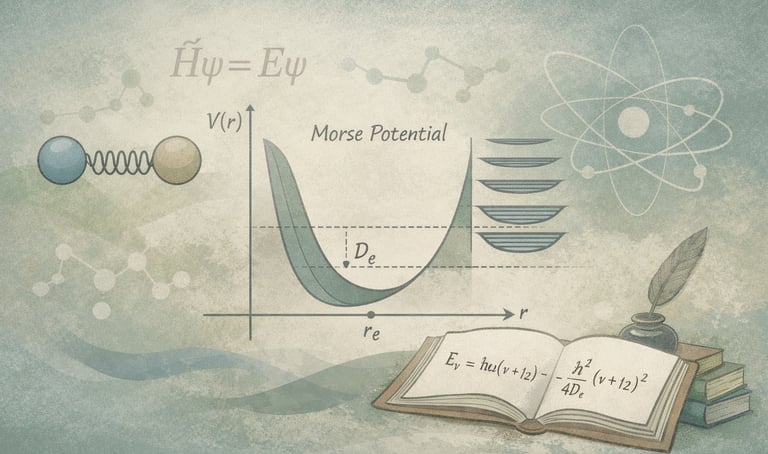
Proposed by physicist Philip M. Morse in 1929, the Morse potential is a mathematical model for the potential energy between two atoms in a diatomic molecule. Unlike the basic harmonic oscillator potential, which assumes bonds stretch like perfect springs, the Morse potential accounts for real-world behavior. Its form is:
V(r) = Dₑ [1 − exp(−a(r − rₑ))]²
Here, Dₑ is the depth of the potential well, related to the dissociation energy, a controls the width of the well, and rₑ is the equilibrium bond length. This expression captures anharmonicity, the fact that molecular bonds do not vibrate symmetrically forever. At sufficiently high energies, molecules can dissociate, breaking apart entirely. This represents a major improvement over the harmonic model, which unrealistically predicts infinite bond strength.
Now comes the real magic. The Morse potential is one of the rare physically realistic systems for which the time-independent Schrödinger equation can be solved exactly. For most anharmonic potentials, one must resort to perturbation theory or numerical simulations. In the case of the Morse potential, however, elegant closed-form expressions for both energy levels and wave functions can be obtained.
The energy eigenvalues for the vibrational states are:
Eᵥ = ħω (v + 1/2) − (ħω)² / (4Dₑ) (v + 1/2)²
where v = 0, 1, 2, … is the vibrational quantum number and ω is the harmonic frequency near the bottom of the potential well. The second term introduces the anharmonic correction, which naturally limits the number of bound states. The associated wave functions involve Laguerre polynomials, familiar from other exactly solvable systems such as the hydrogen atom.
Why does this matter for quantum research? The harmonic oscillator is often too idealized to describe real molecular vibrations. It cannot account for dissociation or higher-order effects such as overtone transitions observed in spectroscopy. On the other hand, more realistic interaction models, such as the Lennard–Jones potential used to describe van der Waals forces, are analytically intractable. The Morse potential occupies a valuable middle ground: it is realistic enough to capture essential molecular physics, yet simple enough to allow exact analytical treatment. As a result, it has found wide application in infrared spectroscopy, molecular physics, and quantum chemistry.
The Morse potential serves as a reminder that quantum mechanics is not all chaos and approximation. Sometimes, elegance hides in the mathematics.
On a lighter note, if you are tired of quantum jargon, I invite you to check out my parody piece “Petrarch was wrong.” In it, I repurpose the Morse potential to model the ups and downs of romantic relationships, proving that even in love, bonds can stretch, anharmonically wobble, and yes, sometimes dissociate. Who knew that quantum physics could explain why couples are not just simple harmonic oscillators?