Quantum Information, Game Theory, and the Future of Rationality
Quantum Speedup May Come from Avoiding Sequential Conditioning
What if part of quantum speedup has nothing to do with entanglement at all? Quantum versions of Kuhn’s theorem (from game theory) suggest a striking possibility: classical information processing may fundamentally require continual sequential reconstruction of global coordination, whereas quantum systems can sometimes encode the coordination directly into a shared state and later recover it through local measurement — even in situations where no equivalent classical local implementation exists.
Faisal Shah Khan, PhD
5/17/20264 min read
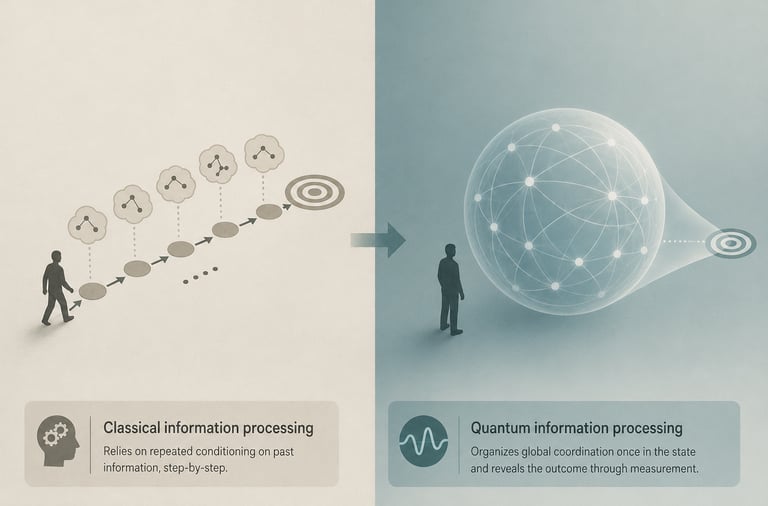
Most explanations of quantum computing focus on things like entanglement, interference, or quantum parallelism. But I think there may be a simpler informational principle underneath at least some quantum speedups. Classical information processing often needs to repeatedly condition on past information step-by-step in order to reproduce a globally desired outcome, whereas quantum information processing may sometimes avoid this entirely by organizing the global informational structure once beforehand through state structure and quantum measurement. In other words, part of quantum speedup may come from avoiding continual local reconstruction of global coordination.
This perspective grew out of recent work on quantum versions of Kuhn’s theorem from game theory and coordination under imperfect recall, which showed that quantum states and quantum measurement can sometimes restore the equivalence between global and local strategies guaranteed by Kuhn’s theorem even when classical local implementations fail. The underlying technical results are developed in my recent preprint on quantum coordination under restricted information and imperfect recall, available here: https://arxiv.org/pdf/2604.27173
From Kuhn’s theorem to quantum coordination
Kuhn’s theorem is fundamentally about a simple but deep question: when can a globally specified process be realized through local sequential operations using only locally available information? In game theory, the theorem says that global and local planning are outcome-equivalent under perfect recall. If agents remember enough history, then a globally randomized strategy can always be implemented through local sequential conditioning. But when recall is imperfect, this equivalence can fail. A globally specified outcome may exist, yet no admissible local implementation can reproduce it.
At a high level, the issue is simple. A globally specified process must be realizable through local operations consistent with the available information. Classically, this means the global objective has to be decomposable into sequential local rules using only the information available at each step. When the information structure is too weak, such a decomposition may not exist even though the global specification itself is perfectly well-defined. That is the core imperfect-recall phenomenon.
Quantum information processing can sometimes restore this equivalence. A quantum state together with quantum measurement can realize the same globally specified distribution even when no classical local decomposition exists under the same information constraints. Importantly, this does not require entanglement, quantum discord, communication, or restoring memory itself. Even separable zero-discord states can suffice.
The key difference is that classical information processing coordinates dynamically through sequential conditioning on history, while quantum information processing coordinates beforehand through shared state structure. Classically, coordination is propagated step-by-step through conditioning. Under quantum information processing, coordination is embedded once into the state and later revealed through measurement. This suggests a different way to think about quantum algorithms more generally.
A different way to think about quantum algorithms
Usually, quantum advantage is discussed in terms of interference, entanglement, Fourier transforms, amplitude geometry, or other specifically quantum mechanisms. Those mechanisms are certainly real, but perhaps they are implementation details of a deeper informational process. Maybe some quantum algorithms work because they avoid the need for continual sequential conditioning on informational history.
Instead of repeatedly coordinating information locally step-by-step like a classical algorithm, quantum information processing organizes the global structure once through superposition and state evolution, and measurement extracts the relevant result at the end. Of course, classical computation also uses forms of preprocessing, caching, shared randomness, and global coordination. The point here is more specific. In imperfect-recall settings, classical information processing loses the general guarantee that globally specified strategies can be reproduced through admissible local decompositions. For the broad latent-variable coordination class considered here, quantum implementations restore that guarantee by encoding the relevant coordination directly into shared states and recovering it through local measurement.
If classical information processing spends substantial effort repeatedly reconstructing and propagating coordination locally, while quantum information processing can encode that coordination globally once, then this difference itself may be part of the source of quantum computational speedup. This interpretation seems especially suggestive for Deutsch–Jozsa and Simon-type algorithms, where a quantum state appears to organize global information before a final measurement extracts the relevant property. Shor’s factoring algorithm may involve a more sophisticated version of the same principle layered together with Fourier structure, interference, and coherent unitary evolution. This does not replace the standard mathematical descriptions of these algorithms, but it may provide a cleaner informational explanation of what quantum systems are actually buying computationally.
The more I think about it, the more Kuhn’s theorem starts to look less like a game-theory curiosity and more like a very general statement about information processing itself. Any computation can be viewed as the problem of realizing a globally specified transformation through admissible local operations under informational constraints. This is a commonly appearing theme in classical algorithms, distributed systems, automata, gate decomposition, control theory, and quantum circuits. Even gate decomposition has this structure, since a globally specified Boolean function or unitary transformation is realized through compositions of local gates from a universal set.
At a high level, information processing may fundamentally be about preserving equivalence between a global specification and a realizable sequence of local operations. Kuhn’s theorem is one precise mathematical statement of this principle in game theory.
The broader possibility
Classically, some target distributions cannot be reproduced locally without conditioning on hidden history, whereas quantumly a shared state plus measurement can restore the same outcome without restoring memory itself. The broader possibility is that some quantum algorithms may work similarly. Instead of constantly updating and propagating information locally, quantum information processing may organize the relevant global structure ahead of time and recover it through measurement at the end.
Quantum speedup may therefore have less to do with strong quantum resources like entanglement or discord alone, and more to do with the informational structure introduced by quantum measurement itself — specifically, the ability to avoid the continual local reconstruction of global coordination that classical information processing depends on.